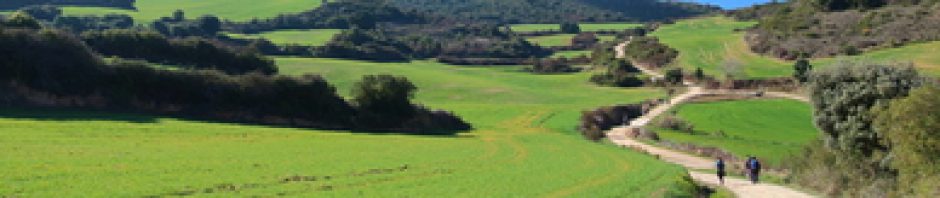
The next morning I left early, around 5:30 a.m., foregoing the hotel’s elaborate breakfast, which wasn’t open until 7:30 a.m. It was dark but I had a flashlight. There was also a full moon and plenty of street lights as I made my way through the old town of Villafranca del Bierzo.
Quickly, other pilgrims began to emerge from the various side streets with the same intentions. I joined in with about 12 of them. From their conversations, I pegged them as from Spain, France, and the Netherlands. Each of us were trying to find our way out of town, and toward the route that tracks the N-VI road. My guidebook listed three tracks to Las Herrerias, by order of difficulty. The N-VI track was the least difficult and from observation, had enlisted most of the pilgrims. The N-VI road itself used to be the main artery through the area until it was supplanted by the A-6 highway. There promised to be a separate walking path for pilgrims, and the traffic was not heavy.
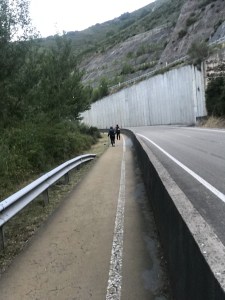
Walking along the N-VI
Before getting to the N-VI, we were winding our way down the country road out of town, when a young Dutch man stopped and pointed to a left turn he was proposing. He showed me his Google map route on his phone. He basically was arguing that we could avoid all the switchbacks — and the extra distance they entailed — by cutting left on this road. It seemed high risk-low reward to me. There was no guarantee that his proposed road would cut through, without encountering a stream blocking our path. Others agreed and we continued as before. The N-VI wasn’t far, and the morning light came up. I settled in for a nice walk to Las Herrerias, with only a gradual ascent. I hadn’t had breakfast and nothing was yet open at the first little village we encountered. The second proved a charm, and with breakfast behind me, the day looked and turned out to be promising.
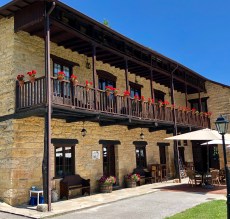
Inn at Las Herrerias
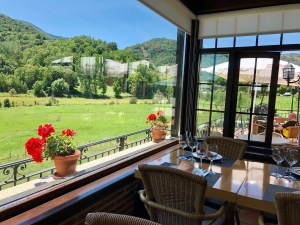
Inn at Las Herrerias
I made such good time on my walk today that I beat Lee to the lodging in Las Herrerias. It was a simple but marvelous country inn, sitting at the base of mountains I would climb the next day. It was only around noon, too early to get into the room, and I didn’t have our luggage anyway. The proprietor got me a large beer and some chips, as I sat in their cool outdoor seating area. This was not any kind of luxury accommodations, but it turned out to be one of our favorite places. I think it had something to do with how it was furnished, and the sight of the mountains. We had both lunch and dinner there, and breakfast the next morning– there was really not much of a town to visit, and I wanted to catch up my writing.
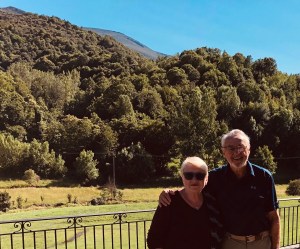
Lee and I at the Inn at Las Herrerias
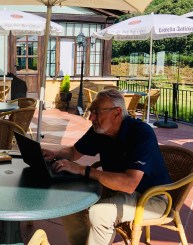
Working on writing in Las Herrerias
Our next stop would be O Cebriero, a mere nine km away, but straight uphill. In planning this trip, I had deliberately scheduled a single day to do the climb. For one, I thought that it would too difficult at the end of a day. For another, I wanted us to spend some time in this celebrated village and not wander in exhausted in mid-afternoon. As I started this morning after breakfast, I questioned that decision. It was only 40 minutes before I had competed about one-third of the day’s walking. How hard could it be?
The mountain proved itself, however. I would be climbing about 2,000 feet over the space of nine km. The first third was the easy part. In the second third, the trail moved from the asphalt road to a rocky path, like the trail I followed coming down to El Acebo. It was easier to navigate a rocky trail going up than coming down, but it still slowed me down. I got up to a hamlet named La Faba, which I knew to be the half-point of the day’s journey. I was still making good time. After the first third, I estimated I might get to O’Cebreiro in two hours. At the halfway point, I extended that to three.
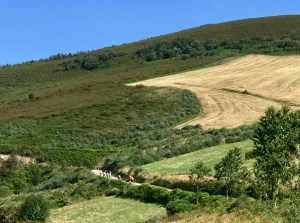
View from the climb to O’Cebreiro
I fell in with an Irish woman in her late 40s who had caught up to me. I walked with her a bit. She was with a group that, excepting her, had opted to ride up to O’Cebreiro on horses. I had read that you could do that. She told me that the group had been spending one week each summer for many years walking some part of the Camino. Some of the children who were part of the original group were now teenagers. It was an annual vacation of sorts. Her story typified the many different ways and reasons people participate in the Camino experience. After a while, I couldn’t keep up with her on the rocky trail and allowed her to go on without me.
The last third of the trek was a killer. Maybe it was because I was more tired after the first few hours, but more likely the steepness of the incline began to take its toll. In the last third of the journey, I had left the hamlet of Laguna de Castille and settled on to an asphalt road. Somewhere, I must have missed a turnoff for a dirt trail for walking pilgrims, because much later I could see them from above. I was mostly surrounded by a few walkers and many cyclists.
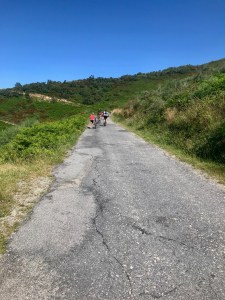
Bicyclists walking their bikes up to O’Cebreiro
My way of walking was simple, to walk for about 20 yards, stop and rest, and then proceed. At one point, I was heartened by seeing a group of young men and women with disabilities embarking on an O’Cebreiro walk with their counselors. Nothing made me feel better than to receive high fives from them and a few “Buen Caminos.”
It was still hard. In that last stage, even the cyclists were walking their bikes uphill. I kept hoping that at every turn in the road that O’Cebreiro would come into view. Clearly I was at the top of the mountain by now! But I would only be greeted by another summit on the horizon where I could see pilgrims and cyclists going up.

Another view from the climb to O’Cebreiro
Finally, the switchbacks leading to another climb stopped and I was greeted with a flat run into the village. O’Cebreiro is legendary and I can now see why. While it is not the highest point of the Camino, it still sits very high and the views are remarkable. As it happened, Lee arrived at the same time as me. After settling into our rooms, we sat for a beer and then had lunch after visiting the local church. It turned out that the owners of our inn were hosting that group of young people with disabilities in the dining room, so we ate in the bar. The owners themselves had a son with Downs Syndrome doing some work around the place.
The now deceased pastor at O’Cebreiro is known to have been a ardent supporter of the Camino and is credited with the iconic signage of yellow arrows pointing the way. Later, after lunch and a nap, we went to the Pilgrims Mass at the church, Santa Maria de O’Cebreiro. It was packed, thanks in part to a youth group from Spain. The priest worked to make the service multilingual, and Lee agreed to do the first reading in English. While I didn’t fully understand the priest’s sermon, I got that it had to do with finding God in the silence of the Camino. After the service, the priest invited all the pilgrims up to the altar and gave us a momento stone with the iconic yellow arrow painted on it.

After Mass with Pilgrims in O’Cebreiro
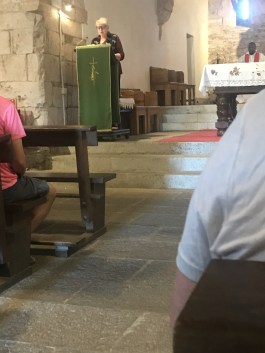
Lee giving the reading at the Pilgrim’s Mass in O’Cebreiro
It was very cool in O’Cebreiro that night. Our room had a window with a million-dollar view of the valley. While our friends and family were coping with a heat wave on the Eastern seaboard of the United States, we slept well clutching our blankets.
 My 2017-2019 Camino