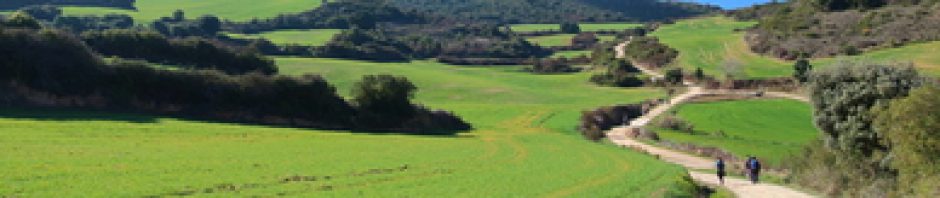
I left O’Cebreiro in the early morning light. There was a fine mist laying over the mountains, giving the place an peaceful if not eerie atmosphere.
A café was open so I got coffee ahead of leaving, and packed some almond cake and a banana. The Camino road stayed high in the mountains for a good time. The scenery on this part of the Camino is truly incredible – it may be the pinnacle of scenery on the French Way.
The road actually climbed higher, above O’Cebreiro, but moved into a gradual descent, followed by a steeper descent, saved only by the gravel and dirt roads. The descent slowed me down and it took me six hours to go 22 km.
I was moving into the Galicia region. The guidebooks say you can begin to smell the sea, but my olfactory senses must have been deficient. Galicia seemed like a never-ending string of dairy farm communities and the only thing I smelled was the scent of manure.
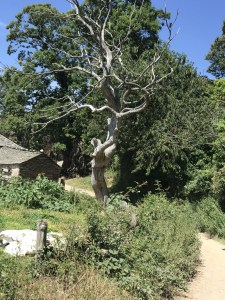
This tree outside of Tricastela can be a metaphor for many things. I just saw it as a work of nature’s art.
I made it to Tricastela where Lee was already at our lodging, a combination of albergue and pension, built for pilgrims. It had its own kitchen for pilgrim use as well as washing machines and dryers. We had a private room in the pension part of the building. Lee and I ate lunch at its restaurant just down the street.
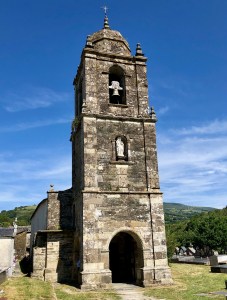
Church in Tricastela
The local church had a Pilgrim Mass at 6:00 p.m. The pews were filled with members of the same youth group we had encountered in O’Cebreiro. I learned from one of its leaders afterwards that they were from a school in Palma de Mallorca, a resort city on an island off the Spanish coast. They travelled with their own priests who said the Mass, not the host pastor, and other leaders led the singing.
We went back to the same restaurant for dinner, after first talking outside of Mass with a man named Benny, who was from Tricastela but now lives in New York. We also stopped and talked with a Belgian couple we had met in O’Cebreiro. The man had given the responsorial psalm in French after Lee gave the first reading in English.
Not only did our pilgrim-friendly albergue/pension have washing machines, it had a 6:00 am breakfast for those wanting an early start. Lee came with me for breakfast. She was going to stay to get our laundry done and wanted to get to the machines before they got occupied. A small group of Germans in their 50s and 60s were the only ones up that early. We both tried to work the confusing, and broken, coffee machine, and with some help from the staff, were successful.
The road to Sarria was not long but involved an early climb. Climbs early in the day are much better than climbs later, and that’s the case most of the time. I set out with a positive outlook: reaching Sarria would be an important milestone and accomplishment.
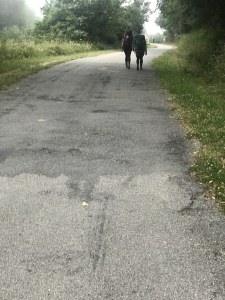
Mother and daughter in the early climb out of Tricastela, mother struggling with the ascent, daughter holding her hand.
In that early climb, there were two Spanish women ahead of me, a mother and a daughter. The mother was struggling and the daughter was helping her. They were holding hands going up the ascent, and the picture seemed too good to pass up. I surreptitiously took their pictures. After about nine km, we had all pretty much reached the summit and the rest of the walk to Sarria was mostly a gradual downhill.
I was feeling good, confident, knowing that I was getting to Sarria where I would start the last push to Santiago. I was listening to a spiritual tape and perhaps not paying strict attention. And so, a catastrophic mistake. I didn’t have the benefit at the time of having someone to follow and I missed a sign and a turn. The country road I was following looked so Camino-like, I never gave it a second thought. I had perhaps walked about 1.5 km off the trail when a motorist speaking only Spanish, stopped me. He clearly was telling me that I was no longer on the Camino but I couldn’t quite get his instructions of how to get back on. I had Google maps on my phone, and basically that was telling me to go back. I was reluctant to do that. Surely, I thought, there must be a way to salvage this walking by cutting over to the trail. In the end, I accepted my losses and walked the 1.5 kilometers back. I had added 3 km to my Camino walk, a totally unforced error.
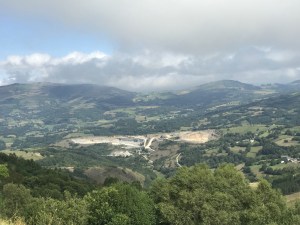
Marble Quarry Outside of Sarria
Once back on the trail, I shook it off. I passed and talked briefly to a Chicago family. I had first met the mother and daughter in Foncebadon, just past Rabanal. The two were now joined by father and son, as they had told me would happen in Ponferrada. Otherwise, I kept to myself. I felt the Palma del Mallorca youth group descending on me. Groups like those seem like a small army overrunning you on the narrow Camino trail. A young Spanish girl passed me trying to get away from them as well and their noise. She told me that almost in apology for why she couldn’t stop to walk with me. I felt the same and picked up my pace.
I still got to Sarria in good time despite the detour. Lee was at the Sarria hotel but we had to wait for a room. We decided to walk into the town hoping to catch a good place for lunch. Lee and I walked the steep uphill to the two churches and monastery, but this being Sunday afternoon, none were open. Nor did we find a decent place for lunch. We came back to hotel and ate there.
Starting with Sarria, the rules for getting the Compostela involve getting two stamps per day in my credencial. With churches closed, my options were limited. The hotel dutifully provided a stamp and I got the second stamp at the pub next door. Not the holiest of sites, but they met the regulations.
 My 2017-2019 Camino