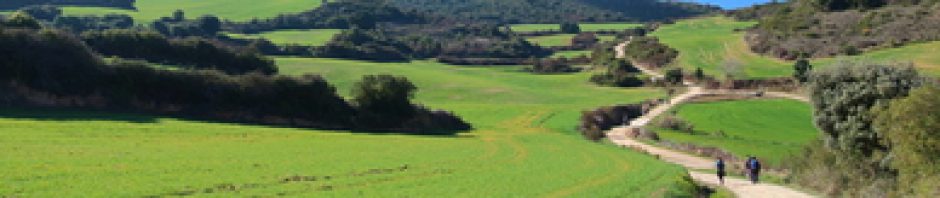
The next day’s destination was Rabinal del Camino. The walk was somewhat longer than what I had done in each of the first three days, and more challenging, with a slow climb of more than 1,300 feet.
On the first three days, I had generally avoided walking with people. I had tapes of lectures by Richard Rohr, a Franciscan based in New Mexico, in my ear. I had wanted to get back into a quiet, reflective mode. This day, I welcomed a walking companion, a Canadian named John, who fell in with me for about five km or so. He was here with his wife, both walking but separately, she ahead of him. He and his wife had walked the Camino before, four years previous, from Burgos to Santiago, and were back doing it again, this time starting in Pamplona. I didn’t find this unusual.
One of the benefits of walking with someone like John, who was in good shape for a sixty-year-old, is that he provided a good pace. You end up walking that same pace. I remember that from last time, when I walked with Jean Baptiste, Louise, and others.
John was good company. As one does, after we established most of our Camino talk, I ended up asking what he did in Vancouver. He demurred, politely, from telling me anything about it. He had made a pledge to himself not to talk about his work life on this trip. I admired him for that and the story tells a lot about the Camino. We in Western culture equate, much too much, who we are with what we do. Here on the Camino, he was trying to get away from that, at least for a time. I was happy to reciprocate, telling him only that I was retired.
When John met up with his wife for coffee in the town of Santa Catalina, I chose to move on. After another five km or so, I found myself in the small village of El Ganso. The church there – all these small villages have churches – was open, It was dedicated to St. James and my guidebook told me it’s an opportunity to meet locals.
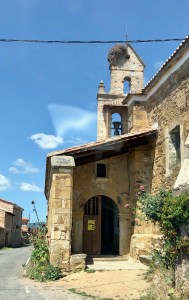
The Church in El Ganso
I stopped in, hoping at least to get a stamp for my credencial. It was Sunday, around 11 a.m., and a priest was starting Mass for no more than a dozen local villagers. What luck! I stayed for Mass, me the only non-Spaniard, indeed the non-villager. I wasn’t a stranger to them of course. They all wished me a “Buen Camino.”
Rabanal Del Camino, my destination for the first day, proved to be a delightful mountain village. The rural hotel was next to a church, which was staffed by Benedictine monks from the nearby monastery of San Salvador del Monte Irago. Later that night, we joined them and a few other pilgrims in the singing of Vespers, and then again in the singing of Lauds the next morning before I set off. Lee stayed for Mass but I had a long day of walking ahead and so I set out before then.
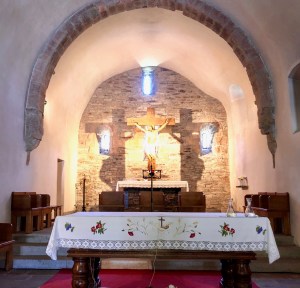
Inside the Church of Santa Maria, staffed by Benedictine monks
This day’s walk was expected to be even more challenging, not in its length which was only about 16-17 km, but in dramatic elevation changes. We would climb about 1,200 feet to about 5,000 feet above sea level, the highest point registered on the entire French Way. Fortunately, the ascent was fairly gradual. We got up to the Cruz de Ferro, a Camino landmark. It was the descent later in the day that would prove to be difficult.
All along the Camino, including at the Cruz de Ferro, it’s traditional for pilgrims to leave mementos of family and friends who have died. I came across a plaque about one such young man, who from the dates given, would have been 17 at his death. The inscription read: “Boats that stay docked at piers remain safe, but that’s not the aim of boats.” Did the young man die on the Camino, like the fictional son in the Martin Sheen movie The Way? Or did the young man just die prematurely, and the parents decided to walk the Camino in his memory? I don’t know. I just know that it was a meaningful quote. I stopped, thought, and prayed for that young man and his parents.
It wasn’t long before I came to the point of rapid descent, about 1,800 feet to the small mountain-pass village of El Acebo. It proved to be my and many others’ undoing. The last 2-3km was nothing but rocks and stones. It slowed my pace by a half. I could only think of having my Camino ended there by a badly sprained ankle, which could have happened at any step. Just as I was thinking that, a 20-something American walking behind me with her boyfriend voiced that same thought out loud. We both laughed, albeit nervously.
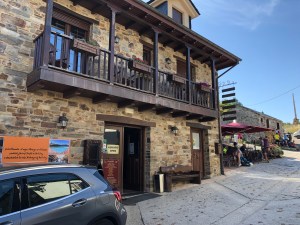
Our Inn at El Acebo
Lee had texted me giving directions to our lodging for the night. It was right where you first come off the mountain and into town. She was perched at a table at its outdoor café, a ringside seat at the descent’s finishing line. She was a witness to all the pained and unhappy faces of pilgrims who had completed that leg of the journey. The Camino is unapologetically difficult, but that stretch seemed unnecessary. I don’t know how many pilgrims really do sprain an ankle or turn a knee on there but it’s probably too many. It was good to be done with it.
 My 2017-2019 Camino