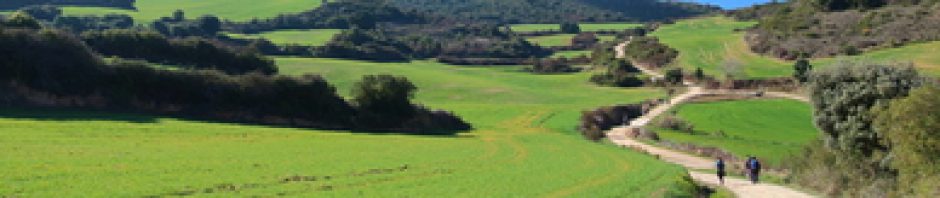
Getting out of Pamplona early Sunday morning, I took a cue from one of the many Camino blogs I had read in preparation for this trip. I ordered a taxi for a 10-minute ride to get me past the hard-paved streets of Pamplona’s suburbs. This landed me in Zariquiagui, a small village that got me instantly back into Camino mode. There were a number of pilgrims already there, some on bike, and with them I stopped in to visit the San Andres Church that is situated there.
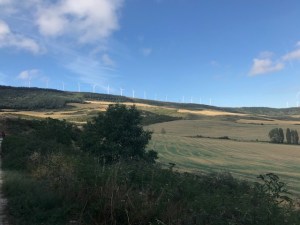
The way up to Alto del Perdon with wind turbines on the far summit
The walk from Zariquiagui to the famed Alto del Perdon (“the Mount of Forgiveness”) is quite steep, yet it felt quite different from the hard climbs on the first two days. For one, I was in better shape, beginning to acclimate myself to the physical challenge of the Camino. But also, I was able to enjoy spectacular views of Pamplona and the fertile Arga River valley. Not to mention that, unlike the first two days, I was surrounded by other pilgrims engaged in the same task as I. On a far ridge were magnificent air turbines, reflecting how advanced Europeans are in harnessing sustainable energy.
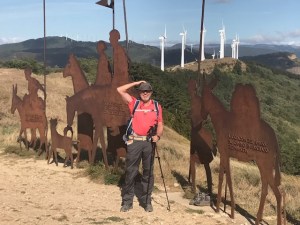
Trying not to get blown away at Alto Del Perdon
I finally did get to Alto del Perdon. It’s “where the way of the wind crosses the way of the stars (“Compostela”).” And, boy, was there wind, enough to have to hold to your hat, if not worry that your whole body would blow away. Pilgrims were taking turns getting photographed in front of the iconic wrought-iron sculpture of classical pilgrims.
We were pretty high up at the time, and I found myself feeling dizzy. The next trek had one walking back down the mountain, and over some treacherous stone- and rock-covered paths. This was the kind of situation where being without a walking partner makes you cautious (not that I couldn’t call on numerous other pilgrims lounging at the top for help). I made myself sit down, breathe slow, and drink some water. After about 15 minutes, I felt better or at least good enough to start the trek down. I figured that, as I descended to a lower altitude, the symptoms would abate, and that’s what happened.
The rock-covered paths are worth talking about some more. Every picture on the web of the Camino shows pilgrims on delightful dirt trails, whether through open fields or sylvan areas. In reality, a pilgrim’s feet touches, as often, much more inhospitable terrain. Some of the dirt roads are not always smooth, which may have the pilgrim alert to avoiding the many tree roots that dot the path. Paved roads, while smooth, are very hard on your feet and knees. The worst however are rock-strewn paths, particularly going downhill. It’s a continual mental challenge to decide where to put your next foot down. One bad decision can lead to a sprained or even broken ankle, and the end of your Camino. It’s mentally tiring to walk like this, and as I wrote before about elevations, changes the calculus about how far you can walk in an hour. My first thought when I encountered these were what yours might have been: why hasn’t someone cleared out this path, given all the pilgrims passing through? And yet, you know the answer. It’s the Camino. It’s not a carefully planned 10k race across the park.
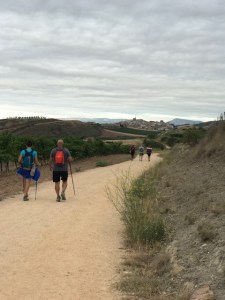
Hilly rocky paths finally gave way to pleasant flat trails…
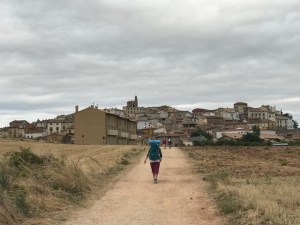
..leading to Muruzabel
I finally arrived at Puente La Reina, found my lodging, and went into my normal routine: a big midday meal, followed by catching up on emails, skipping dinner for a snack, and attending the Pilgrim’s Mass at the nearby Iglesia de Santiago.

