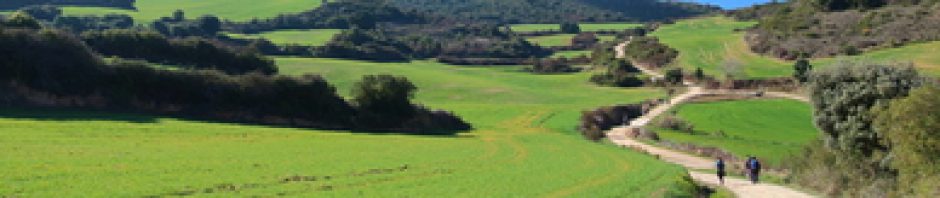
I was committed. By changing our reservations in Santiago, I had to complete the final 54 km in just two more days. Lee and I got up early. My goal was to get to Santa Irene by the end of the day. It would probably take me until at least 4:00 pm.
Our casa rural was located far off both the main road and the Camino trail. We had to navigate a long series of country roads in the dark to get back there. For that reason, Lee decided she would pack up and not return to the casa when she dropped me off. We both crept out of the casa, using flashlights to guide our way. The early morning car ride proved a little scary. The road was narrow with many turns and the early-morning fog made it difficult to see. Fortunately, there were few cars on the road at that hour.
We found the trail near where I had left off, and Lee dropped me there. She was going to get herself some breakfast and find a place to read. Eventually, she would make her way to the next casa rural, which might provide a more comfortable place for her to sit and wait for a room to be ready.
I found a place when I got to Melide that had coffee as well, and then got right back into walking. This part of the Camino is fairly flat, with the exception of a steep climb to Arzua. The town, much larger and more modern that I had expected, was where I had planned to stop for the day (after supposedly stopping at Palais de Rei the previous day). It was near 1:00 p.m. and many pilgrims did appear to be ending their day’s journey. But I plowed on right through the busy center of town into the older part and, just as quickly, moved out of town.
Fortunately, there were other pilgrims who weren’t quitting at Arzua, so I had a few pilgrims guiding my way. I had been relying on road markers which showed up with regularity and kept you apprised of the distance left to Santiago. That was a comfort, assuring me I was on the right, straight path. But at some point, they started just to indicate I was on the complementario, a suggestion that I was on an alternative route. It scared me. Any indicator that I might be walking even one more km than I had to scared me. Also, I was following my guide book and unable to match the towns and markers shown there with what I was seeing. In particular, the guide book listed the “Wall of Wisdom,” a posted series of statements from early philosophers and statesmen. I was sure that I had walked enough miles to see this but I hadn’t seen it yet.
My paranoia had reached a point where I began to think how the various Caminos might come into play there. Arzua, supposedly, is where pilgrims from the Camino del Norte join those from the Camino Frances. Does that come into play here? What is this complementary road, and where the hell is the Wall of Wisdom? Maybe, it was the afternoon walking, something I had rarely done, affecting my brain. At any rate, to my great relief, I finally came to the famous Wall of Wisdom. Soon the waymarkers with kilometer tracking re-emerged and the word complementario disappeared on them.
Later in the day, I ran into a man walking alone that appeared to be my age and so I engaged him in conversation. It turned out that he was about 10 years younger, at which point I realized that, while pilgrims in their 60s are not uncommon, those in their 70s and older are fairly rare. I asked the man where he was from. While he spoke English, it came with an accent I couldn’t quite pinpoint. He said, “Holland.” I then asked him where he started his camino. He said, “Holland.” It turns out that he had been walking for 3-4 months and had covered 2,100 km, about 1,200 miles. He was on the verge of retirement and decided to walk the Camino to mark that event and reflect on it. He looked not the worse for wear, and was looking forward to his lodging in Berea just up the road where there was a promise of a swimming pool.
I got to Santa Irene late in the day about the same time Lee did. Once I knew I could make it that far, I had texted her to confirm the pickup. Since we didn’t know the town (or any others) beforehand, we had no designated pickup point. She would just get there early, find a place near the trail, park and then text me where she was. We relied on GPS coordinates using Google maps. It was never very difficult to find her.
We drove to the casa rural we were staying in that evening. Lee had already been there and deposited our luggage. Like the other, it was a good half-hour of driving to get there and in the opposite direction from where I had been walking. It was booked on the basis that I would stop in Arzua.
I should mention here of my recurrent difficulty in transitioning from walking, meditating, and reflecting on the trail to being a passenger in a car driven by Lee going 40-50 miles an hour. I found it nerve-wracking, and I was always telling Lee to slow down. I was never able to adapt well to that transition.
We reached our casa rural, and while retaining its primitive, rustic, simple style of the previous one, it had much more charm. We had to wait until 7:00 p.m. to eat, but I was able to get a beer after showering and sit out with Lee in their courtyard. We took some pictures to send home. The landlady spoke almost no English nor did the staff but we managed to get by.
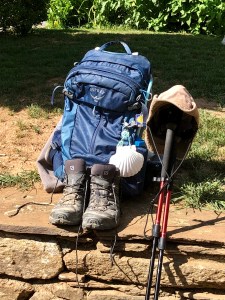
My trusted companions that have gotten me through this journey –tomorrow would be their last day
While it was a long wait for me – I had just a tuna sandwich, banana, and peanut snacks the whole day – we were treated that night to the best meal I had had on the entire Camino. And that’s saying something. It started with the room where we dined, that of a simple country inn elegantly furnished in the style of the region. Our server/cook showed us no menu — we were in someone’s home and were going to eat what we was being served that evening. She asked only a few questions – water with or without gas, wine red or white. She brought both water and wine, and a basket of fresh bread, which I dived into quickly. It wasn’t long before the soup came out, a chicken noodle that we dished out from a soup cistern she placed on the table. An appetizer followed – red peppers stuffed with fish – which must have been a Galician specialty, since we had had it the day before. The main course included roast pork and chicken with potatoes and vegetables served family style. Desert was a Galician cake, basically a Spanish version of tiramisu. The meal did not come with the presentation flourishes of the gourmet meal, which we had had the previous evening. However, its simplicity, the setting, and the dependence on local ingredients — the wine bottle wasn’t even labelled — made it a rare treat.
After dinner, I tried to settle up with our Spanish landlady. She wanted to do it in the morning, but I explained that we planned to leave early. We went back and forth in her limited English and my more limited Spanish to the amusement of us both. She couldn’t get the credit card machine working – I had the sense that someone had helped to bring her casa into the modern technological age and she was still trying to cope with that. I went back to our room to get cash and was able to pay her to her satisfaction. In the process, I learned that our “best meal” cost us exactly 25 euros per person. We should always eat like that.
 My 2017-2019 Camino