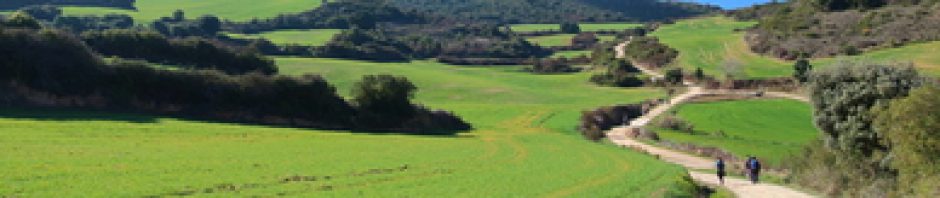
Boredom creeps into the Camino. It can’t seem to be avoided. The towns and villages, and churches, begin to blur in memory and become indistinguishable. Each new place is experienced as a déjà vu.
A woman from Southern California and I were talking about that, just after Fromista. She had been walking by herself for 18 days, starting at St. Jean Pied-de-Port. Sleeping in albergues, she intended to get all the way to Santiago. But she was a grandmother, missing her grandson, and beginning to wonder about all this time away.
I have that resolved for now by deciding to take the Camino in chunks. We’re going from Logrono to Leon on this visit, returning at a later date to finish. But I confess that is a luxury. It is expensive to make so many trips and not all can afford it.
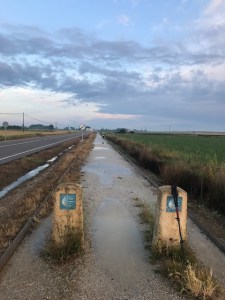
Sendas
The walk out of Fromista introduced me to the sendas or pilgrim autopistas, dirt trails running close to and parallel to the road. These are generally not liked because of the proximity to traffic, but they have one benefit: you can’t get lost. They ran straight ahead with the road, all the way to my next stop, Carrion de los Condes.
I was sluggish walking this day, not with my usual burst of enthusiasm setting off, and it showed in my pace. It didn’t help that I was dodging puddles on the trail. It had rained the evening before. I would have normally done the 12 miles today in five hours, but it took me six.

Carrion is close, but Santiago still far away
I met Lee in Carrion de los Condes outside of our hotel, which was on the other side of the town. It was a converted monastery, faithfully renovated and restored. And to add to the theme, it piped in Gregorian chant softly into the hallways and public spaces. I was too tired to walk back into town to eat and explore, and so we stayed and enjoyed the hotel’s monastic life.

Signs on Camino
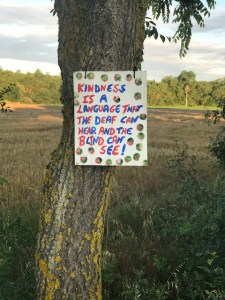
Signs on the Camino
The following day, I would walk only 10 miles, so I stayed around for breakfast, which wasn’t open until the ungodly late hour of 8:00 a.m. By the time I got on the road, I saw no other pilgrims – they were all long gone. The way you learn the way back to the road is to follow, lemming-like, other pilgrims. I didn’t have that advantage today.
Nevertheless, I did find the road and walked in solitude for about an hour. Then gradually, other, younger, pilgrims seemed to be in my wake. I surmised that they had stayed in albergues prior to Carrion and were now catching up to me.
The weather was overcast and cool, with a slight breeze, and we had a nice, soft, level track for walking. Moreover, the land opened up into pure Meseta, planted fields with views in all directions. I had as my companions for most of the day Tchaikovsky and Chopin. I had thought that the wisdom of Meister Eckhart was the perfect complement to the Meseta, but T&C are not bad either. Or maybe it is the Meseta that is the complement.
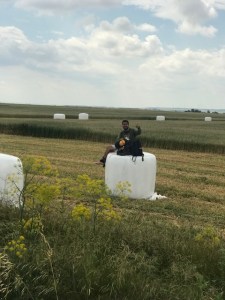
Improvising a rest stop on the Meseta
Whether due to the weather, the peaceful Meseta, or the music, I walked the 10 miles to Calzadilla de la Cueza in record time, about 3.5 hours. I met Lee and we had lunch, and stayed the rest of the day in our hostal.
One of the common experiences on the Camino is to encounter someone whom you ran into earlier but had not seen for awhile. An African-American woman from Sacramento walked in to our hostal. I had last seen her on the road to Belorado, about a whole week before. We talked a bit but she was just there for lunch, intending to sleep another nine km down the road.
There were also two Spanish men, in their fifties, whom I had seen on an off. They were checking in, intending to stay for the night. Both had serious weight issues, and whenever I encountered them on the road, they seem to be laboring in the heat. At one such encounter, they looked so tired, I asked if they were “ok.” I don’t know why they were walking the Camino, whether for health reasons, religious reasons, or just to reflect on a change in life or the loss of someone close. They only spoke Spanish and I wouldn’t pry anyway. Whatever the reason, it was difficult not admire them.
The night before I was to set out for Sahagun, I was convinced that it would be the day I would first walk the Camino in the rain. The forecast was bleak. I had gotten out my rain jacket and pants. I was prepared and resigned to do it. However, when I woke up, I learned that I got a reprieve. The rains weren’t expected until that afternoon.
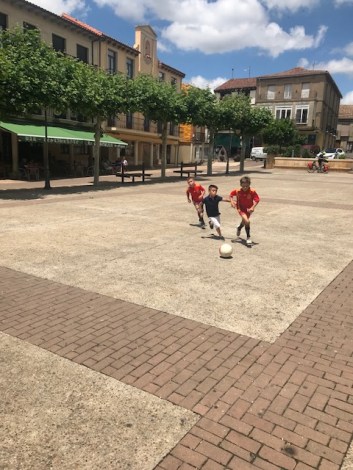
Spanish boys playing soccer in Plaza Mayor in Sahagun
Lee and were determined to get to Mass in Sahagun. We had not been to Mass since Burgos, not for lack of churches but for a dearth of priests. It would be Sunday when we got to Sahagun, and even though it was a town of substantial size, we determined that there were only three Masses there that day. We did manage to make the 12:30 Mass at the Church of San Lorenzo. We found the rain as we were walking from our hotel to it. After Mass, the sun returned. We went to the town square, the Plaza Mayor, and had lunch.
Later, we visited a medieval convent that was being renovated and now served as museum for the Camino. There I had my credencial stamped and received a certificate for having completed over half of the Camino Frances. As they say, it’s all downhill from here.
 My 2017-2019 Camino