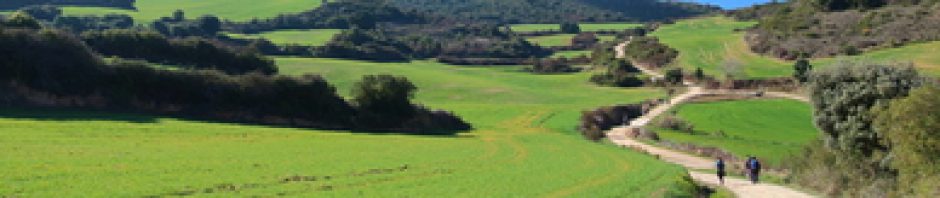
Burgos is only 50 km from Belorado. About 30 miles. I certainly could have walked it in two days. However, the best itinerary for lodging would have had me walk 18 miles that first day. That seemed too much given the steep ascent into the Oca Mountains. I opted for three days, with a stop at Villafranca de Montes Oco, only about seven miles down the road. At the beginning of the day, I was feeling stronger about my walking and regretting that decision, that is, until we got to our destination. This small wisp of a town, barely 200 inhabitants, boasts as its main lodging option the San Anton Abad Hotel and Restaurant.
The buildings comprising the hotel and restaurant were constructed in the 14th century when it served as a hospital, not a medical facility but a refuge for pilgrims on the Camino. Now renovated, it feels like you are living in the owner’s house on a large Spanish estate. I arrived just past 11:00 a.m. Lee was already there. After eating, we spent the rest of this short walking day in blissful solitude in the various courtyards and vernandas. Lee was organizing her notes on this trip and doing some pre-reading for catechetical training she was undertaking next month. I was catching up with writing and escaping from the Camino by reading one of Arnaldur Indridason’s Icelandic mysteries, books I had brought on my IPad for just that purpose. We would have been happy staying there a week.
I left Lee early the next day for Atapuerca. It was a difficult start, three kms straight up the Oca Mountains. By the time I reached the summit, I was nearly eye-level with one of the many wind turbines that dot the mountain ridges all across the northern part of this energy-smart country. The rest of the day, first to St. Jean de la Ortega and then to Atapuerca, was much easier but relatively boring by Camino standards. I had my tapes and spent some of the walk to St. Jean in the company of Kelly, a northern California suburban mother of two (“living the dream,” she explained with a wry smile). She was here with her mother on a bus and walking group tour—a little walking and a little riding – for which she was more than a little defensive. I repeated what she knew and I had truly internalized – everyone does their own Camino. No judgment here. Walking with Kelly was helpful. She set a good pace for me to follow and we got into St. Jean’s in good time.
When I arrived in Atapuerca, another four miles down the road, I sensed that the amenities accompanying our stay there would be more limited. My first impression was that this was like many of those dusty, forgotten towns you pass through driving in rural Colorado or Wyoming – a gas station, a store, and a few houses. The towns that used to be on the main road before they built the interstate, and since which, have been on a progressive decline. I was even more locked into that impression when I found our bed and breakfast hard to locate. I had to call Lee to guide me to it. But Atapuerca would be full of surprises.
Our B&B turned out to be an empty house we had to ourselves. Lee called the proprietress who let her know where she could find the key. Nothing fancy but full of character – a stone and timber house more than 200 years old.

Getting in our “house” in Atapuerca..

.. and at Comosapiens with “Nocho”
After settling in, we set out to find some place to eat, with low expectations. The one restaurant we had targeted was serving only dinner that day. We were making our way back to a little café, where we figured we might get some beer and snacks at least, when we met a French woman with the same goal. We were guiding her to our café when she mentioned that she had found another restaurant but it was demanding 25 euros for a fixed-price meal. La Comida in Santo Domingo or Belorado was never more than 15 euros. I was intrigued. After pointing our French friend to the café, Lee and I walked in the direction of that restaurant.
We walked in and I confess it looked pretty classy, waiters in black vests and pants, for example, but with only a few tables occupied. We looked at the menu, and it was indeed 25 euros a person and that did not include wine! Still, we thought, let’s try it. Sorry, they said: All the tables were reserved. I thought: “No es possible!” That you needed a reservation to eat in this town was hard to fathom. But seeing our puzzlement, they offered to make up a table in the bar area for us, and we took it. The owner/chef “Nocho” came out personally to go through the menu, for which he was very proud. Long story short, we had stumbled on to a four- or five-star establishment.
The restaurant’s name was Como Sapiens, a play on the anthropological finds in the area. Atapuerca, we learned, is the source of the earliest human remains ever found in Europe, tracing from 1.2 million years ago. It has been declared a UNESCO World Heritage site.
For the next hour or so, we were treated to a gastronomic feast. The bill, with wine, came to 60 euros, about $80, for a meal that would have cost $250 in DC, that is, if we could have gotten a reservation. It was an extravagance on the Camino, and one might criticize us for it. But the Camino reminds me that God is in all creation. And what Nocho did with local ingredients in his creative and imaginative way (cheese ice cream!) seemed a sacred act.
We wondered back to our abode. It was hot. Chickens were huddled in a corner of their pen to get into the shade. Same with the stray cats that lay about. I tried to turn on the television to watch the World Cup, but just after it turned on, it turned itself off. I think it was telling me that it was time for siesta, both for it and me. I let it alone.
Our house, with its exposed stone walls, was cool. Lee and I passed the next three hours in silence, living in this moment of being in this house in Atapuerco. Another gift of the Camino.
I left around 7:30 the next morning, leaving Lee to sleep some more. I scrounged some instant coffee and a muffin that someone had left. A few peregrinos, mostly younger who had stayed in one of the alburgues, were about. Also, some Irish girls whom I had helped find their bed-and-breakfast the day before, as I was looking for ours. I walked mostly alone this day. After an ascent of 3-4 miles, Burgos, as promised, came into view. I stopped at a café and talked to a Welsh couple, Dave and Sarah. I had seen them gently placing a stone at the mountain top and taking pictures of it. Dave explained that they had brought it from their home county. A symbolic gesture of what? A gift between countries, cultures, lands? Whatever it meant, it seemed right.
There were many options on walking into Burgos. I was fixed on coming through the suburb of Castanares. I would have completely missed that turnoff, were it not for three 10-year-olds running a lemonade stand at that very spot. I dropped two euros to enjoy a small class. When I was leaving to go further down the road, one of the girls asked “Castanares?” And then she pointed to this little path behind her, barely visible. On my second day on the Camino, I accepted directions from a little dog. I would certainly not have doubted that 10-year-old girl.
So I could avoid walking through industrial areas to the city center, Lee and I arranged to meet up just outside of town. We found our hotel in Burgos near the Cathedral, parked

Lee at the Cathedral in Burgos
the car in its garage, and quickly pulled together our laundry for a same-day turnaround. In the evening, we toured the Catedral de Santa Maria. It is one of the most grand Gothic cathedrals in all of Europe and our quick visit couldn’t do it justice. After the tour, we attended Mass in a side chapel, then had an ice cream in the public square, completing our visit to Burgos.
 My 2017-2019 Camino