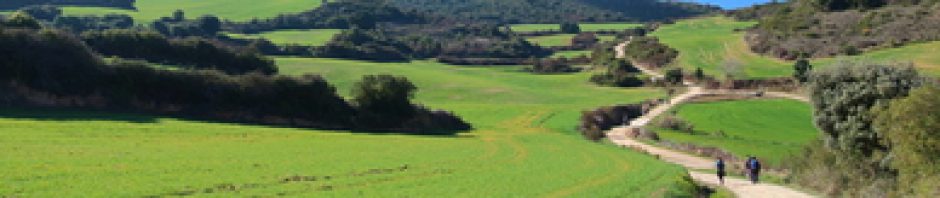
It has been 10 months since I left the Camino to return home to Washington, DC, to be with my wife. Lee, who was to have cardiac bypass surgery. That surgery was successful, and she has completely recovered. So, I have now returned to the Camino to finish what I started. This time, Lee is with me. Not to walk. She’s not up to that yet. But to meet me at each town and share the pilgrim experience that surrounds the walking. Below is a continuation of the account of, now, our journey.
The Camino is not easy to get to from the United States. When I started in St. Jean last August, it required planes, buses, trains, and automobiles. This time, our destination was Logroño, a city near where I had left off. We flew from Washington-Dulles airport to Madrid, via Paris, but because of flight delays, missed our Paris connection. So instead of getting to Logroño in our rental car at the decent hour of 6:00 p.m., we straggled into the hotel at 11:00 p.m.
The unexpected gift, however, was being able to drive to Logroño in twilight. The skies, painted a dazzling red-orange, were those I had before seen only in New Mexico. Clouds seem to caress the mountains in front of us. They also seemed quite low, almost eye-level. A puzzling sight, until we realized that we had already ascended very high into those mountains.
We used the next day to recover from jet lag, visit the Logroño Co-cathedral of Santa Maria de la Redonda, and watch World Cup matches in a cafe. The World Cup is best watched in a soccer-crazed country. Spain qualifies.
My walking started the following day. I was anxious about this return. By my seventh day on the Camino back in August, I had developed a rhythm. Although 12-14 miles a day was still not easy, it had become very doable. I wondered if I would feel the same way. I trained much less for this trip – a mere two days of walking in Washington, DC.

Me with my new friend Alex
A short while after passing the village of Naverrete, Alex, a local man not a peregrino, approached me and asked if he could walk with me. He wanted to practice his English. A native Spanish speaker, he was conversant, if not fluent, in French and English, but it was difficult to maintain that fluency without practice. I accepted his invitation. Alex and I walked about four miles together, from outside of Naverrete to Ventosa, another small village. His company made my first day’s walk easier and faster. Alex was a talker. He told me all about his life, his falling out and reconciliation with his father, his taking care of his mother, his taking over and eventually closing the pottery factory that was his father’s business, his ownership of property in the area, and, of course, Spanish politics. Alex also was very knowledgeable about the Camino, its long history and resurgence since the late 1990s, when UNESCO first declared it a World Heritage site.
After Alex left me, I walked the mere six miles left to get to Nájera, getting in much earlier than I expected, about noon. Lee was already there and had checked in. We found an excellent place in town for me to introduce her to almuerzo or la comida, the great Spanish tradition of the mid-day meal. We feasted on ensalada mixta, hake fish and chicken, and chocolate cake. With a bottle of rioja wine, of course. We then found a famous monastery in town to tour, and a local church that would have Mass later. But we were still tired and we decided against both in favor of an early bedtime.
The next morning, I was determined to get an early start to Santo Domingo de la Calzada. Nájera at 6:30 a.m. is a ghost town. The locals are still fast asleep, with memories of la cena from the late evening before. Only the peregrinos are awake, stumbling about town. I found some in Bar Naxara, a café catering to peregrinos. Like me, they were getting a morning coffee, poring over their guide books, adjusting the straps on their backpacks, and looking to the day ahead. Not with trepidation about the physical task ahead, mind you, but with an eager anticipation with what the day might bring.
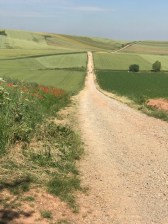
The Way seems to stretch forever…
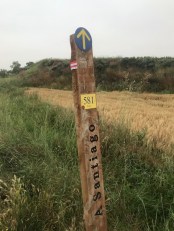
…with still 581 km for me to go.
I walked first to Asofra, a small village with cafes and markets, and while I didn’t stop to eat, I picked up some fruit for the road. The Camino wound its way through farmland and vineyards, with wide dirt trails that were silent and peaceful in the early morning. We had to climb a steep ascent to Cirueña, but that would be the hardest part of this day’s trip. Spain is littered with cities and towns whose history traces to the medieval times or earlier. But there are just as many modern little towns, like Cirueña, which appear to be within the warranty period of their construction. It even hosted a beautiful golf course, the Rio Alto Golf Club, located right on the Camino. I, an avid golfer, couldn’t resist walking into its pro shop in my Camino gear, my worlds of spirituality and golf colliding.

Santo Domingo!
The rest of the way to Santo Domingo was an easy descent. There is something wonderful on the Camino when your destination first comes into view. You walk up a hill, for example, and when you reach the top, there it is. Perhaps still 3-4 kilometers away, but within reach. I got that same thrill seeing Santo Domingo.
I met up with Lee and we found a nice outdoor café to eat. Then back to the hotel for a siesta. We woke up a little while later, bought some crackers, cheese, fruit, and wine for dinner in our room. We then went to Mass at the small chapel adjoining the Cathedral of Santo Domingo de la Calzada, where with others, I got my credencial stamped and received my first pilgrim’s blessing for this trip.
The third day took us to Belorado, I walking and Lee driving. But Lee had a plan for a detour. We were only about an hour’s drive from Bilbao and the Guggeheim Museum. The opportunity was too good for her to pass up. Inasmuch as she wouldn’t get to Belorado before 2:00 p.m. with this side trip, I left much later than usual, around 8:00 a.m., so that we could arrive in Belorado around the same time. The plan worked.

Me and Jean-Baptiste
Lee had fun communing with Chagall, but I had an interesting day myself. I had never before spent much time walking and talking with other peregrinos, but this day, I spent considerable time with two of them. First was Jean-Baptiste, a 40-something French man, who had started the Camino in St. Jean. I can stumble through some French, but Jean-Baptiste was also quite conversant in English. I had seen him at Mass the evening before in Santo Domingo. We talked about various things, including faith and religion, an easy topic to engage on the Camino. He interpreted for me what the priest’s sermon, the evening before, was about. Lee had caught much of it relying on her college Spanish, but Jean-Baptiste was able to expand on her account with important nuances.
I left Jean-Baptiste at Granon, because I wanted to have time alone with my audiotapes. I was finishing a lecture series on Karl Rahner’s theology of grace and looking to get back into the poetry of Gerald Manley Hopkins. (These are the luxuries of walking for hours alone on the Camino!). But after another 4-5 miles, I happily accepted an invitation to walk with Louise, a French-Canadian woman, traveling by herself. Louise had started her Camino in Tours, France! By the time of our meeting, she was well-conditioned for walking, and her pace reflected it. Louise was planning to go all the way to Santiago and even then to Finisterre, the Atlantic coast.
Like with Jean-Baptiste, Camino conversations have a way to get past the trivialities of our lives to deeper issues with which we are wrestling. Louise had been raised Catholic but was not practicing any more. My conversation with her moved from those trivialities to meditation (not helpful for her) and Tai Chi (helpful). And then on to anger (never useful) and to forgiveness (hard at times but forever freeing, libre in Louise’s Quebecois French). Were we talking about God, like I did with Jean-Baptiste? I would say so.
I left Louise at a small town along the way and continued on to Belorado. CaminoWays, our tour company, had reserved a charming bed-and-breakfast there. I got there about 15 minutes before Lee, enough time for a cerveza. We shared reports of our day over lunch and then went back to read, write, and sleep in no particular order. We then attended the Pilgrims’ Mass at 7:00 p.m. in the neighboring church. The priest took great care and pride with the pilgrims’ blessing afterwards, bringing us to a separate nave and altar, and had us both praying and singing together for 30 minutes, almost as long as the Mass. He learned all of our nationalities and invited us to sing a native hymn or song. We were thus serenaded by songs in French, Korean, Chinese, and Spanish. Luckily, I was surrounded by some Americans. We contributed spirited renditions of Amazing Grace and This Land Is Your Land.
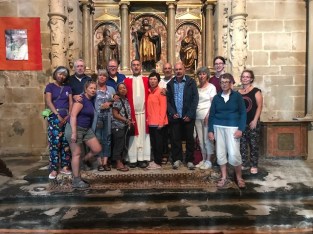
Pilgrims’ Blessing at Belorado
A great end to a great day for both of us.
 My 2017-2019 Camino