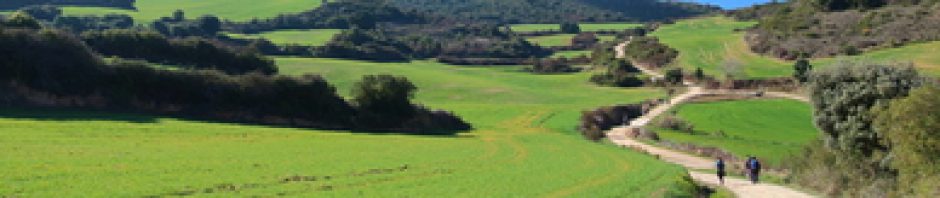
The walk to Zubiri would be my first at a more typical daily distance, about 22 km. Up until this point, I had not walked more than 12 km, so I was a little apprehensive. Yet, my Brierley, which by now I was consuming — every graph, map, word — promised a pleasant and easy day. And it was right, mainly dirt paths, wooded and shaded, and a gradual descent into the Erro and Arga river valleys.
I started early again, at first light, skipping the formal breakfast that didn’t open until 7:00 a.m. Perfectly placed about three km outside of Roncesvalles was a breakfast café, where I was able to have an egg sandwich, orange juice, and the most delicious coffee, as well as buying fruit to take along the road. Coffee is my marker for assessing the development of civilization. Northern Spain passed easily. And who knew that flat, dirt roads could be so pleasant? Also, for the first time, there were fellow pilgrims all around me. No danger of getting lost. I had joined the contingent who had walked straight from SJPP to Roncesvalles.
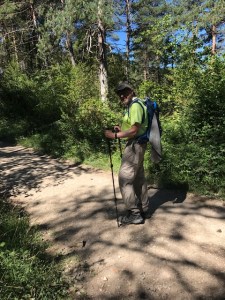
On the road in full gear
We passed through Burguette, a quiet little hamlet where Hemingway had spent many years holed up writing The Sun Also Rises, among other pieces. It was warm but not hot, certainly nicer than the weather currently in D.C. While not having long conversations, it was easy to converse briefly with fellow pilgrims. Mostly, there was just the simple acknowledgement of being tied together in a common quest: “Buen Camino.” Whether with Spanish, Italian, Australian, or Korean pilgrims, the same affirmation exchanged.
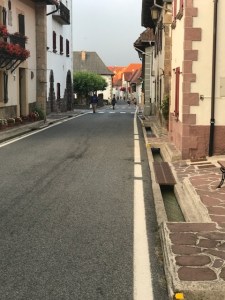
The pretty little village of Burguette
Zubiri itself was the first 21st century town I had encountered on the Camino. Roncesvalles was more an expanded college campus, SJPP a medieval town kept that way. Zubiri seemed no different than a small town in rural Colorado off the interstate. My lodging for the night looked like a truck stop, a small motel, gas station, bar and restaurant. I had my midday meal at the bar, while the bartender filled me in on life in Spain.
It’s worth sharing here how I’m managing accommodations. I’ve made a few concessions to age. The “traditional” approach is to carry everything on your back as you move along the way, “all your worldly possessions,” or at least all you need to live in Northern Spain for 1-2 months. You sleep in albergues, open dormitories set up every 10-20 km to accommodate pilgrims. These are on a no-reservation, first-come, first-serve basis, which causes one a little anxiety if you’re walking in August, the busiest month. Yet, this approach is most consistent with the idea of pilgrimage. It allows each day to be its own creation, how fast or slow you walk or how much ground you cover, without the certain knowledge of where at the end of the day you will lay your head. Like pilgrims before you in the medieval times, not to mention Joseph and Mary, you may have to deal with “no room in the inn.”
I would have had no problem with that in my twenties or thirties. Indeed, I did a version of it with my friend Joe Gavin, when we successfully hitchhiked across the U.S., Philadelphia to San Francisco, nearly 50 years ago. But I knew if I were to complete the Camino, I needed two things: privacy and sleep. Neither are promised by the albergues. Therefore, I’ve made arrangements with a travel company to secure reserved accommodations, which ensures that I’ll have a room, however modest, each evening. That same company moves my duffel bag each day so that I can limit what I carry to the contents of a daypack. So, like clockwork, when I arrived at the Zubiri lodging, my duffel bag, which I left at the hotel in Roncesvalles, was right there waiting for me.
That evening, I learned some troubling news from my wife, Lee. She had had a routine cardiac stress test that morning and the doctor advised her to follow up with a further diagnostic procedure. It was Friday night; the procedure was scheduled for Tuesday. We agreed that there was no good reason for me to come home. In the worst case, the doctors, if they found a blockage in her artery, might put in a “stent” in the affected spot right then and there, a routine procedure. Our oldest daughter would accompany her to the hospital. Still, the news weighed on my that evening, and my sleep wasn’t helped by the fact that some of the locals were doing Friday night partying at the bar down below.
 My 2017-2019 Camino