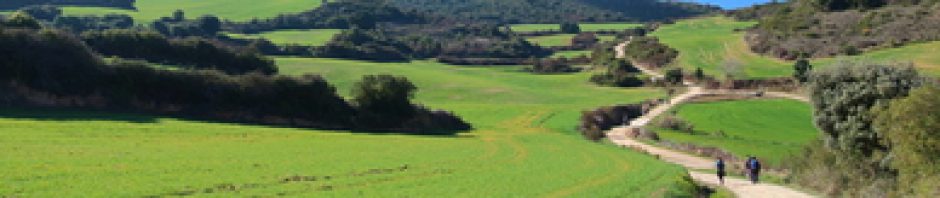
I started the next morning early, skipping the traditional breakfast in favor of fruit and snacks for the road. The sun was burning off a beautiful, early morning mist that had enveloped the mountains. It was a glorious sight and I was trying to enjoy it, trying to “get into the moment,” one of the many goals I had for this journey. But frankly I couldn’t stop worrying how I was going to survive another day like yesterday.
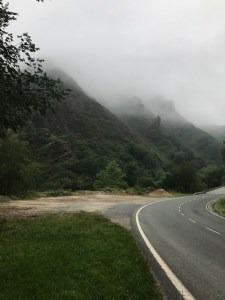
Early morning mist over the Pyrenees
The trail out of Valcarlos led one to the side of a heavily traveled road. With industrialization, more of the Camino now has the pilgrim walking on the side of major highways. This comes with some peril. You have to ditch any thoughts of a meditative reverie, so as not become road kill. I did that. The asphalt roads were filled with truckers up early delivering materials and supplies to support the community’s farming interests. That in itself could have been my meditation that morning, the honesty, satisfaction, indeed prayer, of physical labor. But I was mostly just on the alert for the sound of a truck coming around the bend and the availability of a safe spot to stand and let it pass.
At some point, the Camino veered off the paved roads to small dirt paths through beech and hazel woods nestled on the side of the mountains. I had lost sight of any other pilgrims by now, the dirt paths had turned into footpaths, and I was wondering whether I had taken a wrong turn somewhere. Could this still be the Camino? The path was barely a yard wide. I stood at a clearing to get my bearings and try to guess where the path continued among the various choices of downtrodden turf on the other side. A small dog came scampering down the hillside, presumably from a house up top, yapping away at me. After he finished his scolding, he headed to a place on the other side of the clearing, beckoning me to follow. I did, and then noticed an almost imperceptible yellow-painted arrow and shell that is the universal Camino directional signal. The dog walked with me for about 100 yards, before turning back. His job done for today, another pilgrim safely put on the right track.
The last stretch to Roncesvalles turned out to be the most brutal of the first two days. Had I been more familiar with my Brierley (a popular guidebook), I could have anticipated that, and with proper expectations, prepared myself. It shows a climb from about 400 meters above sea level at Ganocoleta, about five km outside of Valcarlos, to 950 meters where Roncesvalles sits. At the time, I just knew that for about three hours the steep ascent was unceasing. My mind kept telling myself that the path cannot continue to go up. It must level off at some point. But it just never did, until that is, a few km outside of Roncesvalles.
I was sitting at a water station after that arduous climb when a young Spaniard, walking with his 60-something mother, came through. I must have looked like hell, because he approached me to ask if I was ok. I was, but in defense and looking for some validation, said something to the effect that “that last stretch was really hard.” He was huffing and sweating a little himself and nothing made me feel better than to see him smile and reply, “Yeah, it really was!” The three of us walked the final way into Roncesvalles.
Roncesvalles itself has only 30 permanent residents, and appeared, with its small hotels, dormitories, medieval buildings, and large green spaces, like a college campus. It seems to exist solely to support the Camino. After showering and eating, I wandered around. It was a beautiful summer day when we arrived, and pilgrims were scattered around lying on the grass taking in the sun. Up to this point, I still had not encountered a single American, but got close with a conversation with a guy from Vancouver about my age. He and his wife were cycling to Compostela.

Even at Roncesvalles, still a long way to go!
In the evening, I found my way to the Iglesia de Santa Maria for the Pilgrim’s Mass. Three priests were there to concelebrate, and at the conclusion, like at SJPP, they asked the pilgrims to come forward for the traditional blessing. The priest surprised all by repeating the blessing in at least 7-8 languages, including Korean to the delight of some Korean pilgrims. A great way to end the day.
 My 2017-2019 Camino