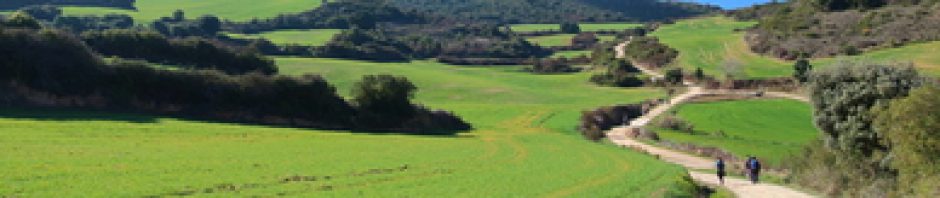
St. Jean Pied de Port (SJPP), literally “at the foot of the pass,” is a very pretty, walled town in Basque country, the French Pyrenees. I would never have imagined being here, nor I suspect would many of those I see walking about, except for one thing. It is the traditional starting point for the Camino Frances, the most popular of several routes that are the Camino de Santiago, the Way of St. James.
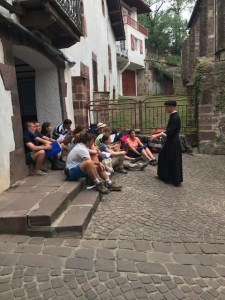
An impromptu a capella chorus on the street
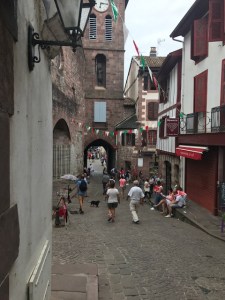
Street Scene in SJPP
Nearly 300,000 pilgrims (“peregrinos”) walk one of the various Camino routes each year, and I’m hoping to add to that number. Nearly 800 kilometers to the West lies our common destination, Santiago de Compostela. That’s about the distance between my home in Washington, DC and Toronto, Canada. As I contemplate that fact, with a fair amount of trepidation, I scramble to remind myself why I’m here. I do have many, very good reasons, but in answer to the question, all that comes to mind right now is “it seemed a good idea at the time.”
I tell myself that I’m not walking to Santiago de Compostela. I’m walking to Valcarlos. a mere 12 km up the road. And after a nice dinner and a good night’s sleep, I may wake up and decide to walk to Roncesvalles. In approaching the Camino, I’m taking a cue from Alcoholics Anonymous: one day at a time.
I have checked the Las Vegas betting boards, and the “over-under” on me is two weeks. Frankly, I think that a tad optimistic. But I’ve done a lot of research on the Camino and, among other things, learned that the only rule of the Camino is that there are no rules. Well, there is one. In order to receive a Compostela, a document certified by ecclesiastical authorities that you have completed the Camino de Santiago, you must provide evidence only that you completed the last 100 km of the journey. You provide the evidence by stamps made into your Pilgrim’s Passport (credencial). Most people who walk the Camino (travel by bicycle or even donkey is available) do so in 4-6 weeks. But the largest group of pilgrims start in Sarria, conveniently located a little more than 100 km from Santiago de Compostela. It takes about one week. Many others, particularly Europeans and others trying to match the Camino with vacation schedules, complete it in annual segments: two weeks one year, two weeks the next, etc.
I had thought about completing the Camino in segments over several years. That’s a reasonable strategy for someone like myself, now entering my 73nd year. And it may well be my fate, given the possibility of injury, exhaustion, and other obstacles pilgrims routinely encounter. If so, I’ll be fine with that. No regrets. But right now, my intention is to take this journey to its conclusion.
I arrived today late in the afternoon. It’s worth recounting how I got here. First, an overnight flight from Dulles airport (Washington) to Charles de Gaulle (Paris), followed by a bus to the Gare Montparnasse in the center of Paris, then a high-speed train (TGV) from Paris to Bayonne, followed by a taxi which meandered over the French Pyrenees to SJPP. That was the theory. To deal with the inevitable jet lag and ensure I would arrive at SJPP at a reasonable time in the afternoon, I did decide to stay overnight in Paris, But, as luck would have it, my train to Bayonne the next day was cancelled. Mechanical problems with the lines and tracks for trains going to Southwestern France had snarled the whole system. I was re-routed by a cattle-car bus to another train station in Paris with the plan to take a different train two hours later. Three hours later I got on that train, which was standing-room only because of all the displaced passengers.
My first-class, reserved seat that I had booked and paid for was worthless on this train, of course. However, I did manage to corral a seat, well a jump seat, in the baggage area between two train cars. Now the French around me took this all with resignation and humor. “Welcome to France,” they chuckled to me, an obvious American. And remarkably so did I. I was in Camino mode. If I couldn’t pass a simple Camino test as this, I figured, I should just turn around and go home. Of course, it didn’t hurt to have that precious jump seat.
After some fits and starts, I did get to Bayonne and then shared a taxi with a Belgian family (father, mother, and daughter) to SJPP, arriving more than five hours after I had planned. No problem, I was here, and happy.
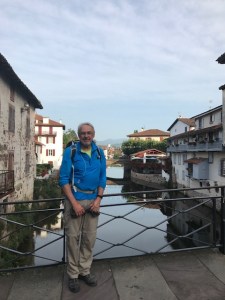
Ready to Go
The Way of St. James, as a pilgrimage, traces back to medieval times. St. James was one of the original 12 apostles, the brother of St. John the Evangelist, both the sons of Zebedee. When he was beheaded in 44 A.D., legend has it that his disciples returned his body to Galicia in Northern Spain, where he had spent much time preaching Christianity. In the ninth century A.D., remains were found that were believed to be those of St. James, and these are now entombed at the town that bears his name. The city has become a major destination for Christian pilgrimage, surpassed only by Rome and Jerusalem.
Which brings me back to my original purpose for doing this: El camino es tiempo de meditación interieur, no intinerario turística. The training hikes up the C&O Canal in early morning, the hours spent mining the wisdom of twenty-something clerks at the REI store on everything from socks to backpacks, the careful navigation of airline fares and French train schedules – they are all behind me. Tonight, I began preparing myself for pilgrimage, starting with a Pilgrim’s Mass at Eglise Notre-Dame du Bout du Pont (yes, where it is, is what it’s called). At the end of Mass, the priest, speaking all in French, invited all the pilgrims to come forward for a blessing. He first asked us each a question and I got enough of it to reply in the following in my best schoolboy French: “Je m’appelle Robert et je viens des États Unis.” I think I was the only one from the US, the others rattled off Australie, Allemagne, Belgique, etc. As the priest blessed us, I wished all of you, my family and friends, to be there with me — and you were, in my mind and heart.
To share a maxim quoted in my Guidebook: “I am not a human being on a spiritual journey. I’m a spiritual being on a human journey.” Tomorrow, I set out to get back closer to who I really am.
More to come. Wish me luck, better, wish me Buen Camino.
Bob
(For more pictures showing the charm of St. Jean Pied de Port, check out http://ilovewalkinginfrance.com/5-unforgettable-moments-in-saint-jean-pied-de-port/
 My 2017-2019 Camino